You have already chosen the category, so this guide skips the "which product" debate and answers the question that comes after it: how to start a building block brand that actually ships. Here is what it takes, this year, to put your own name on bricks.
You have seen the shelves and you know a gap exists: a theme nobody has built, an audience nobody serves. By the end you will know the three realistic routes to a branded brick product, the safety certificates you personally must hold, the money picture without fake precision, and a first-90-days roadmap that turns the plan into a shipment.
I am Karsa, a sourcing agent based in Zhaoqing, Guangdong; the company is registered in Zhongshan, which is why we present ourselves as Zhaoqing & Zhongshan. My brick orders run through the Guangdong toy cluster, and that is where this map begins.
01 The Quick Answer: What It Takes to Launch a Brick Brand
The answer in one paragraph
As of November 2026, a small buyer can launch a building block brand from China by pairing an original theme with existing-mold production, your own colors and packaging, and per-market safety certification. Typical entry MOQ is around 500 sets, negotiable by design complexity. The realistic path: sample first, pilot order second, series third.
What a brand actually is here
Starting a brick brand is not buying a factory. It is a trademark, an original theme, and a first product that carries both - one set or one line that proves the idea. The molds, the molding machines, and the packaging lines are supply you rent, not identity you own.
What you own, what the supply chain owns
You own the theme, the artwork, the packaging, the certificates in your name, and the customer relationship. The chain owns the machines and the making. A launch plan is the act of keeping those two lists clean and separate.
Where this guide goes next
Market first, then geography, then the three routes, then compliance, then money, then a 90-day roadmap. If you are ready to order today, how to order OEM brick sets is the step-by-step path. If you want to see what a finished program looks like first, browse our custom building blocks program.
02 Why Building Blocks Are Worth a Serious Brand Play
The market picture in numbers
As of November 2026, the numbers worth knowing: the global building blocks market was about 9.1 billion US dollars in 2025, and it is projected to grow about 7.6 percent per year through 2035. One market research firm estimates the market leader held about 58 percent of revenue in 2025. The same firm projects its share easing toward 50 percent by 2035, as compatible-brick suppliers and regional brands broaden the market. That projection belongs to the research firm; I am not making a forecast. Chinese brick brands are growing fast, and the shelf they are taking share from is the largest one in toys.
Why small brands can live next to the giant
The category does a lot of the work for a small entrant. Open-ended replay value drives repeat purchases, and parents extend collections a set at a time. Adult collectors now buy display sets at premium prices - a buyer the market barely used to have. And because a well-designed theme keeps selling while the bricks in it stay compatible with standard-size bricks from major brands, a brand that owns one good theme owns a long shelf life.
What the share shift means for you is what it does not require. You do not need to beat the market leader on shelf breadth. You need one theme, one audience, and one channel you understand, executed well enough that customers come back for the next set.
03 Where Your Bricks Actually Come From: The Chenghai Cluster
One third of the world's toys, one district
Most of the world's bricks are made in China, and a large share of them comes from one place: Chenghai, a district of Shantou in eastern Guangdong. Chenghai produces roughly one third of the world's plastic toys and about half of China's, and its share of building blocks specifically is even larger than its toy share. Mold making, injection molding, coloring, printing, and packaging all sit within a short drive of each other, so a new part, a color match, or a packaging prototype cycles in days rather than weeks.
What the cluster does for a small order - and what it cannot do
For a first-time brand, that density changes what a launch feels like. A new part can be cut and trialed locally in days. A color match can be tested while you wait. A small trial order that a standalone factory would refuse is normal work inside the cluster. What the cluster cannot do is tell you who actually has the machines: it concentrates middlemen too, and a company with no production line can quote brick projects from an office. Before any deposit, how to verify a Chinese factory is the checklist I run on brick suppliers, and it belongs in your process too.
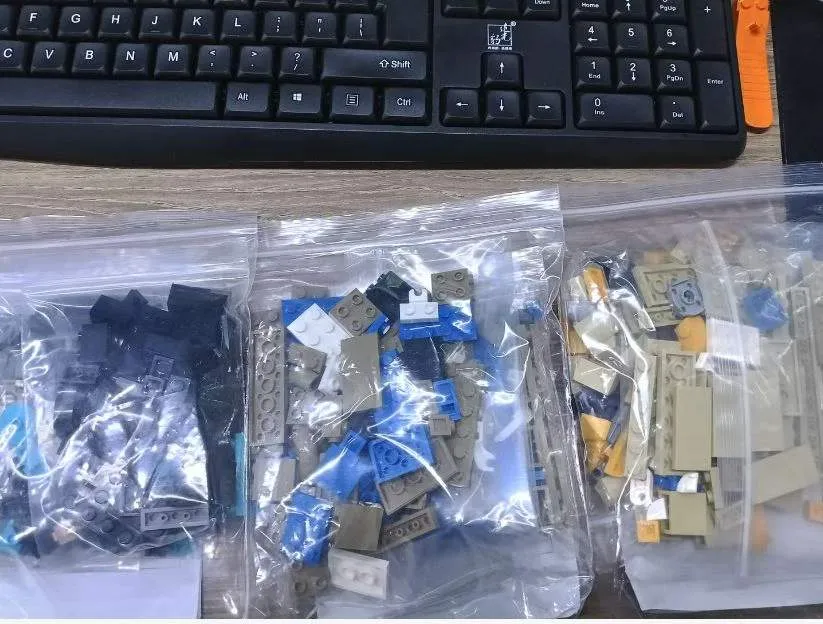
Bulk compatible bricks, sorted and bagged: the raw material of a private label set.
04 Three Routes to Put Your Brand on Bricks
The strategic choice is not how much to customize - it is how much you build from scratch. The same supply chain supports three routes, and the difference between them is investment level: what you bring, what the factory brings, and what moves the cost.
Route 1 - Existing molds, your colors and packaging
The lowest entry, and the best first product for most new brands - private label in effect, though the branding is entirely yours. You pick from existing mold shapes, then specify your color scheme, printed logos, packaging, and instruction booklet. No tooling, MOQ around 500 sets negotiable by design complexity, and the fastest route to market: the first product can read as fully yours without a single new part. You bring the theme, the target age, and the channel; the factory brings the molds and the molding. What moves the cost is piece count, packaging level, and per-market testing. For the framework behind this route, how private label manufacturing works goes one level deeper.
Route 2 - Semi-custom: new pieces on an existing base
One or two new pieces, or a run of printed tiles, on an otherwise existing base. The set keeps an existing platform's economics but gains a signature element no other set has. Mold cost here is a one-time setup that amortizes on repeat orders, which is why the semi-custom route suits a product that has proven demand and now needs to defend it.
Route 3 - Fully custom set design built to your brief
The highest route: your own theme, own parts list, own instructions, built by the design team from your concept. Highest differentiation, highest entry, and the right route when the theme is the product - the set only exists because you thought of it. Everything you bring on Route 1, you bring here too, plus patience for design rounds.
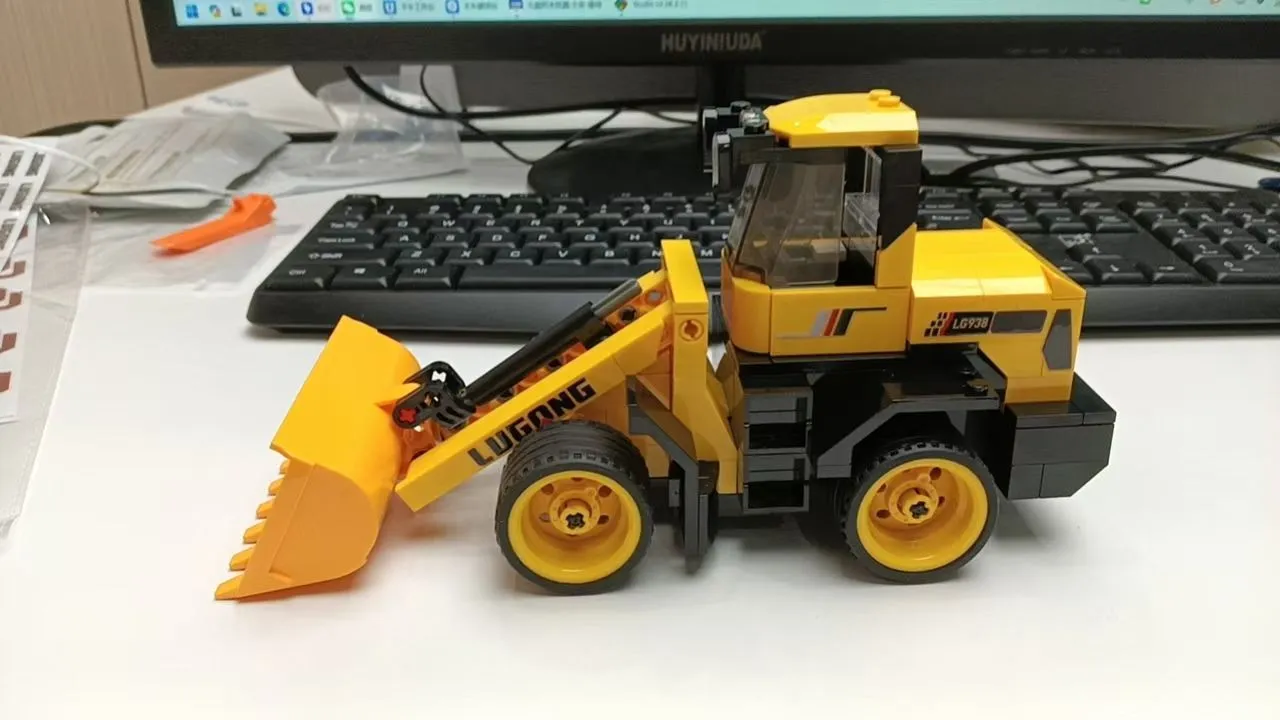
A machinery model built from existing molds with custom color and print - the semi-custom route in practice.
Mold ownership, settled before the steel is cut
Whenever a route involves new tooling, ownership and exclusivity get settled in writing before tooling starts: who owns the molds, who may use them, and for whom they may be used. Mold ownership and tooling costs is the full treatment; the step-by-step order path covers the order mechanics around it. This guide deliberately stays one level above both.
05 The Certificates You Hold Yourself: US and EU Toy Compliance
Here is the part most factory-written content gets wrong: the certificates are yours, not the factory's. A factory can hand you test reports; it cannot hand you the legal position of the importer. For the full country-by-country map, see import compliance requirements by country; this section is the toy-specific planning layer on top of it.
United States: F963-23, CPSIA, and the CPC you issue
Children's toys sold in the US must be tested to ASTM F963-23, the mandatory standard under 16 CFR 1250. They must also meet CPSIA chemical limits, including strict lead and phthalate limits and small-parts testing for products intended for children under three. Then comes the step competitors skip: the Children's Product Certificate is issued by the US importer - you - based on test reports from a CPSC-accepted laboratory. Not by the factory, and not by the lab. If you are the importer of record, the certificate is your document, and tracking labels on the product and packaging are your obligation too.
European Union: EN71, CE, and the GPSR responsible person
The EU side runs on EN71 testing and CE marking for toys. One addition has applied since December 13, 2024: the GPSR, the EU General Product Safety Regulation, which requires an EU responsible person named on the product or packaging, together with manufacturer contact details. The EU also adopted updated toy safety rules in late 2025, which phase in a digital product passport; your testing lab confirms what applies to your set when you book.
Sequence testing before production, not after
Sequencing is a launch decision, not an afterthought. Decide your target markets before molds are cut, because a mold for a market you never enter is wasted tooling. Book testing when the pre-production sample is approved, in the exact configuration you will mass produce. Budget testing as a per-order cost, per market. We arrange testing support per order; the certificates and the legal responsibility sit with you, and your lab confirms current requirements. This is experience, not legal or tax advice.
06 The Money Picture: Tariffs, Landing Cost, and Thin Margins
US: roughly 20 percent at the border
As of November 2026, US-bound building blocks carry a 7.5 percent Section 301 layer plus an additional 12.5 percent layer on China goods - roughly 20 percent combined on top of the product price, before freight. I state both layers plainly and predict nothing about either of them. For planning, the point is that a US launch budget carries the border cost from day one. How to calculate landed cost is the method page, and how Section 301 tariffs work is the mechanics page.
EU: zero duty, real paperwork
EU- and UK-bound toys enter at essentially zero customs duty - the EU tariff schedule keeps toy lines duty-free - but zero duty is not the same as cheap. GPSR compliance, testing, and responsible-person arrangements are real costs, and the paperwork is where the money goes. The short version: the EU is cheap at the border and expensive in paperwork, and the US is the reverse.
Where the margin lives
Margins on unbranded compatible bricks are thin - a fact of the wholesale layer, not a secret. The margin lives in brand, theme, and repeat orders, which is exactly why you are building a brand rather than reselling bulk. What moves the money, in order of leverage: piece count, mold count (one-time, amortizes on repeats), packaging level, testing per market, and freight mode. To turn those variables into a first-order plan, the first-import budget framework is the page that frames it.
07 Frequently Asked Questions
Do I need a big budget to start a building block brand?
No. The entry cost of a brick brand is flexible because customization has levels. Your first product can use existing molds with your colors, logo, and packaging, which keeps tooling at zero and MOQ around 500 sets, negotiable by design complexity. New molds are a later decision for flagship products. Total first-order cost depends on piece count, packaging, testing, and freight, so confirm a quotation for your own design before you commit.
What is the real minimum order for custom brick sets?
Most custom set orders start around 500 sets, and the number is negotiable depending on design complexity. A set built from existing molds can often start lower; a set needing several new molds starts higher. Bulk loose bricks are sold by weight or piece count, which suits buyers who assemble their own kits. Confirm your exact minimum with a quotation before you plan your launch cash flow.
Do I need new molds for my first set?
Not for your first product. You can launch with existing mold shapes, your own color scheme, printed logos, custom packaging, and your instruction booklet, and the set still reads as yours. New molds become worthwhile when a design proves demand or when you need a signature part no competitor has. When you do open molds, settle ownership and exclusivity in the contract before the steel is cut.
What certifications does my brick brand need for the US and EU?
For the United States, children's toys need testing to ASTM F963-23 and CPSIA chemical limits, and as the importer you issue the Children's Product Certificate yourself, based on reports from a CPSC-accepted laboratory. For the EU, the EN71 standard and CE marking apply, and the GPSR adds responsible-person labeling. Arrange testing per order and per target market before mass production. This is experience, not legal or tax advice; your testing lab confirms the current requirements.
Are compatible bricks legal to sell?
Compatibility itself is not the problem. The standard brick connection system is public, and many brands sell compatible bricks legitimately. The line you must not cross is copying: protected set designs, another company's logo, characters, or packaging look-alikes. That is why our design work starts from your own theme, not from someone else's product. A brick brand built on original themes and clean artwork stays on the safe side.
Can you help me launch my brand, and what do you charge?
Yes. I am a sourcing agent based in Zhaoqing, Guangdong. I match your project with brick factories in the Guangdong cluster, coordinate design, samples, and packaging, arrange pre-shipment inspection, and consolidate your order with my warehouse. My fee is a commission of 5% to 15% of the order value, set by order complexity and order size. Send your theme and target quantity for a quotation.
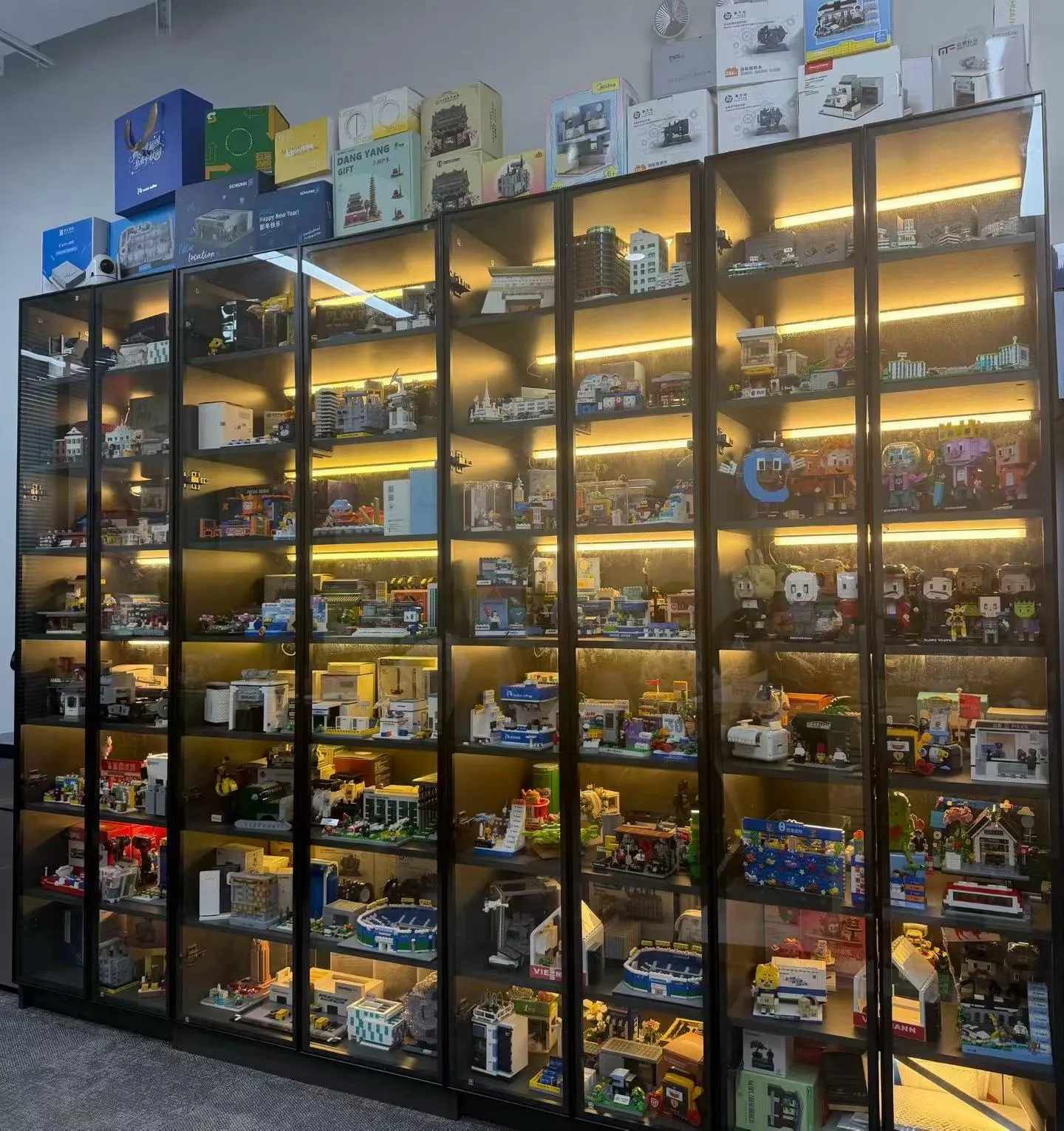
A retail collection on lit shelving: what a finished brand looks like at the shelf.
08 Your First 90 Days: A Launch Roadmap
The 90-day frame is a planning shape, not a promise: testing queues, packaging artwork rounds, and holiday factory schedules can each stretch a step. Here is the sequence.
- Days 1-15: pick the theme and the audience, then write a one-page design brief - theme, target age, piece-count range, packaging idea, target market. Everything downstream quotes against this page, so make it specific.
- Days 15-30: send the brief for quotation. Get the design and the parts list back, and confirm MOQ, mold needs, the testing plan, and packaging in the same round, so nothing re-opens later.
- Days 30-50: approve the pre-production sample - color, fit, print, and build feel, in that order - then book testing for the approved configuration, not for a draft of it.
- Days 50-75: mass production with in-line QC, and the pre-shipment inspection booked before the goods leave the factory. The pre-shipment inspection checklist is what gets checked.
- Days 75-90: consolidate and ship. My warehouse holds goods free for 15-20 days while an order consolidates, then air freight buys launch speed and sea freight from China buys unit economics. Receive, sell, and collect the first repeat signals before committing to a series.
My scope is the China side: finding the factory, coordinating design, samples, and packaging, booking the inspection, and consolidating the order before shipping. The trademark, the certificates, and the compliance decisions stay with you. To picture the end state first, browse finished set and bulk brick examples; that work runs on a commission of 5% to 15% of the order value, set by order complexity and order size. Send your theme and target quantity on WhatsApp at +86 19898484442, or through the contact form, and I will come back with a plan against your one-page brief.
Karsa has been helping e-commerce sellers and businesses source products from China since 2016, serving clients from 23+ countries.
 WhatsApp Karsa
Find Karsa on Social Media
Follow for sourcing tips, factory insights, and product updates from China.